


Editor’s Note: This is the beginning of a short series on time periods in the Bible that follows up on a previous series from three years ago.
About three years ago, I wrote a four article series on Time Periods in the Bible. In preparation for a series on the Kingdom of God, I would like to return to the topic of time periods. How you view time periods in the Bible greatly affects how you read, interpret, and apply the truth that the Bible contains. In this article, we will review the basic concepts, further develop the two major options for how to understand time periods (and place the various sub-options on a continuum), and list specific practical concerns that differentiate the options.
Review from before
In the previous series on time periods, I concluded the series with several major practical considerations:
- The entire Bible is the narrative of God’s plan, and as such is useful for teaching, reproof, correction, and training in righteousness. No part of the Bible is more important than another in a general sense.
- There are aspects of pre-Pentecost life, including sacrifices and observing days (to just name a few examples), that no longer apply directly to the post-Pentecost Christian.
- The Old Testament provides the backbone for the Bible. In the Old Testament, God revealed His plan to redeem mankind through the nation of Israel. Many aspects of the Old Testament were unclear, but shine much more clearly through the life of Christ Jesus.
- The Gospels display the powerful mission and life of Jesus the Messiah. Even though Jesus lived and died, rose and ascended before the day of Pentecost, he is our greatest example of how to live God’s way. As such, the Gospels are generally applicable to the post-Pentecost Christian.
- The Epistles are, in part, designed to show how God’s plan as revealed in the Old Testament became fulfilled through our Lord, Jesus Christ. The Epistles also offer a variety of advice on how to live life through the spirit since that aspect of life has changed from before Pentecost.
I still stand behind these words. I want to build even further on these practical considerations in this series of articles.
Two major options for understanding time periods in the Bible
In the first of the four articles from three years ago, I briefly contrasted the two major options for understanding time periods in the Bible: dispensationalism and covenantalism. In this article, I wanted to highlight some of what I have learned by studying this more in the past few years and provide some thoughts behind a continuum of beliefs in this area. Starting at the macro level, the primary difference between the two approaches is that dispensationalism focuses on discontinuity, while covenantalism focuses on continuity. It’s easy to remember that because dispensationalism starts with the letter “d” and covenantalism starts with the letter “c.” The primary similarity between the two frameworks is that both agree that God has changed how He has dealt with mankind through the ages. Basically everyone agrees that things have changed over time, especially at big moments (the giving of the Law; the death, resurrection, and ascension of Jesus; Pentecost). Instead, the disagreements center on the things we discussed three years ago:
- The place of the Law of Moses
- Literal or figurative Biblical interpretation
- The place of Old Testament prophecies about Israel
- When did the Church begin?
- What was God’s eternal plan?
Underpinning most of this disagreement is the question: is there a distinction between Israel and the Church? In their book Kingdom Through Covenant, Gentry and Wellum correctly say: “It is our conviction, however, that the sine qua non (necessary condition) of the view (dispensationalism) is the Israel-church distinction, which is largely tied to their understanding of the covenantal differences between the ethnic nation of Israel under the old covenant and the church as God’s people under the new covenant. For all varieties of dispensationalism, ‘Israel’ refers to a physical, national people and it is not the case that the church is the New Testament replacement of historic Israel in God’s plan of salvation, as, for example, covenant theology teaches.”[1] They go on to explain that this is precisely why dispensationalists see more discontinuity in the Bible: the Church is something new that is separate from God’s dealings with Israel; thus, the rules that apply to Israel do not necessarily apply to the Church, and so on.
Putting various options on a spectrum
So now that we understand that the main difference between all dispensationalists and all covenantalists is how we view the Church in relation to Israel, our next question is to ask: what other things are important? What kind of options exist for the smaller issues? Based on our beliefs, where do we fit on the continuum? I am not a big fan of labels, but I do think that it is helpful to know what people agree and disagree on and why. This type of deeper understanding helps us in our discussions with other Christians, as well as with those outside the Church or those who are newer to Christianity.
Dispensational options
For those who believe that Israel and the Church should remain separate, there are several major options. Interestingly, these options have developed over time as scholars have researched the Bible and compared Biblical teachings with the teachings of dispensational scholars.
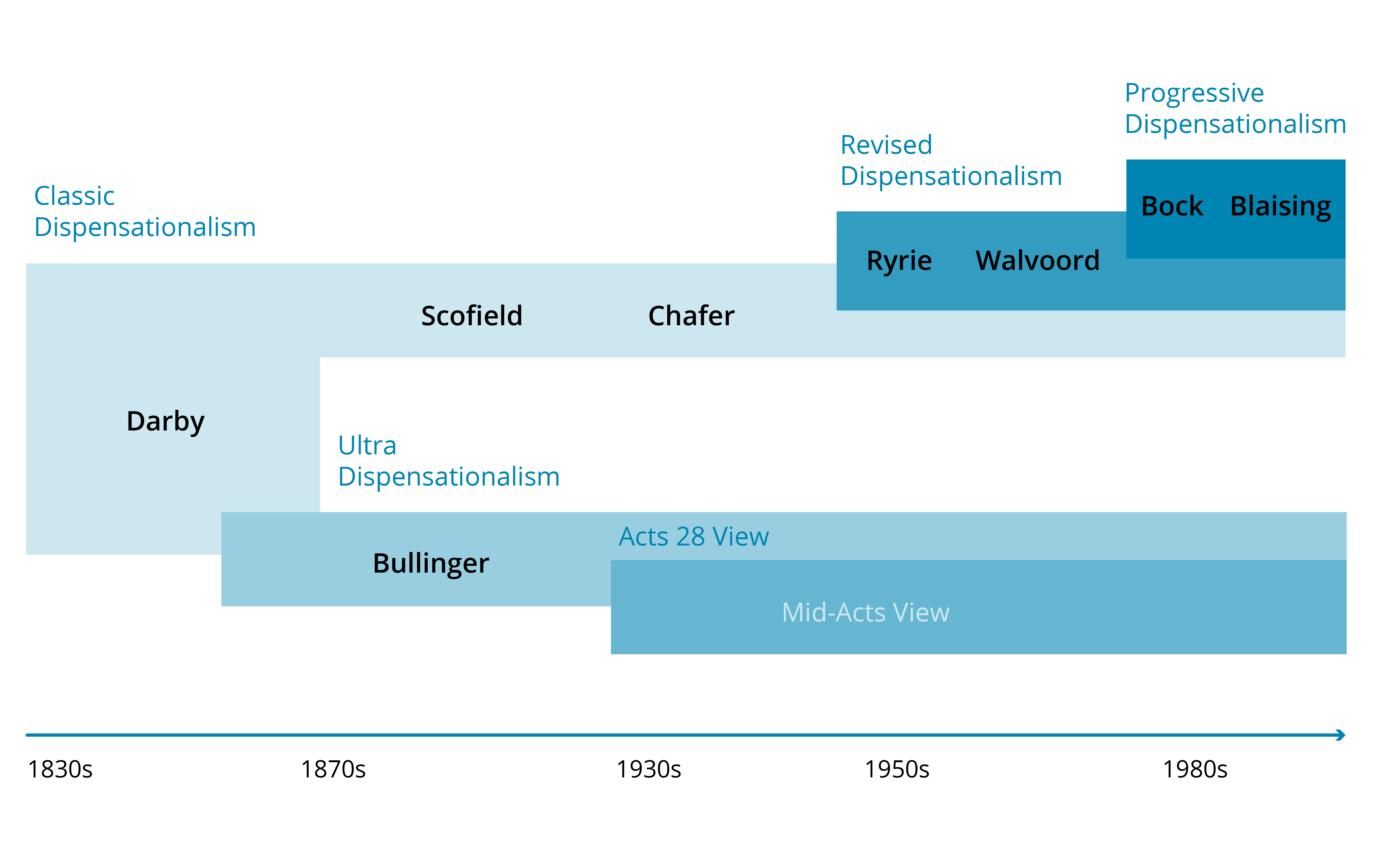 Chart Credit: Paola Ely (Twitter: @paola_palooza)
Chart idea source: https://en.wikipedia.org/wiki/Progressive_dispensationalism
The first proponent of dispensationalism was John Nelson Darby. Classical dispensationalism was advanced by C. I. Scofield (of the Scofield Bible) and Lewis Sperry Chafer (a disciple of Scofield). Famous scholar D. L. Moody was also trained as a dispensationalist. Early dispensational thought took two basic paths: one leading to ultra-dispensationalism and its successors, and the other leading to progressive dispensationalism. I will compare these views in four different categories: view on the kingdom of God, view on the kingdom of heaven, view on the Church vs. Israel, and view on the promises in the Old Testament (OT). Some dispensationalists distinguish between the kingdom of heaven (which is sometimes defined as the political rule of Christ on the Earth in the end-times) and the kingdom of God (which is sometimes defined as the way that God rules spiritually throughout all time periods in the Bible). Also, dispensationalists differ in how they interpret the Church/Israel distinction. Some see the Church and Israel as completely separate, while some see the Church as more of an extension of Israel (in line with a more covenantal approach). Similarly, some dispensationalists see all promises to Israel remaining reserved to Israel, while some see the Church receiving some of the benefits of promises originally made to Israel. Here are the major differences between the views leading to progressive dispensationalism [2]:
| View on the kingdom of God | View on the kingdom of heaven | View on the church vs. Israel | View on the promises in the OT | |
| Classical | The way that God rules spiritually throughout time. Not a political kingdom, but a kingdom of spiritual authority.
Completely distinct from the “kingdom of heaven.” |
The culmination of the prophecy to David that his son would rule for eternity. In other words, this would entail a political kingdom with physical land.
Completely distinct from the “kingdom of God.” |
There are two types of redeemed people: earthly and heavenly. The earthly people receive the promises of Abraham (“the land”) and the heavenly spend eternity unbound by earth. The church was the first group of people to whom God revealed His heavenly purpose. | All promises to Israel are reserved to Israel (including the promise of the new covenant in Jeremiah 31). |
| Revised | Began to see that the “kingdom of God” and “kingdom of heaven” were synonymous terms. | Charles Ryrie and John Walvoord began to teach that there was a spiritual kingdom in the present dispensation—that Christ rules over Christians in some sense today—with the full governmental fulfillment to come in the future. | Still view Israel and Church as separate, but do not make a distinction between earthly people and heavenly people. | The new covenant is now viewed as applicable to the Church in a spiritual sense, with the literal fulfillment coming in Israel. The Church is a “spiritual fulfillment” of the covenant to Abraham. The land promises and such were still reserved to Israel specifically. |
| Progressive | There is no major distinction between the “kingdom of heaven” and the “kingdom of God.” | Believe that the future kingdom in its fullness (the “not yet” aspect) will bring about the specific promises to Israel (“the land”), first in the millennium and then in the eternal kingdom. | The Church is a progression from Israel. Jewish Christians receive the literal benefits of the promises from the OT in the coming kingdom. | The new covenant is now viewed as totally applicable to the Church. The physical fulfillment will still come at Christ’s return. A Jewish Christian will receive the land promises of Abraham, and a Gentile Christian will experience the promises for his/her ethnicity. |
What about the ultra-dispensationalist branch (including the mid-Acts and Acts 28 views)? What are the differences and similarities in those options? All three of these views hold that four critical truths were lost towards the end of Paul’s ministry. These four truths are:
- The Distinctive Message and Ministry of the Apostle Paul
- The Pre-Tribulational Rapture of the Church, the Body of Christ
- The Difference between Israel and the Church, the Body of Christ
- Justification by Faith Alone, in Christ Alone. [3]
Belief in point four (but not necessarily that it was lost) is shared with many Protestant groups. Belief in point three is shared with any dispensational view. Bullet points two and one are more characteristic to the ultra-dispensationalist views. In addition, all three of these views typically reject water baptism and charismatic gifts. Some reject the Lord’s Supper entirely, while others see it as a memorial and not as an ordinance. All typically place the teachings of Christ in the Law (or Mosaic) dispensation.
Now, where do these three views disagree? [4] They disagree on how to apply Paul’s Epistles and how to view the book of Acts.
| View on Paul’s Epistles | Views on Acts | |
| Ultra-dispensationalism (Bullingerism) | Although Bullinger later wrote that Paul’s Epistles were applicable only if they were written after Acts 28:28, most of his writings are compatible with the view that all of Paul’s Epistles are applicable to the Church dispensation. | Added an extra dispensation to account for the period of time between Pentecost and Acts 28. |
| Acts 28 | Only takes the prison Epistles (Ephesians, Philippians, Colossians, and Philemon) to be addressed to the Church. | Added an extra dispensation to account for the period of time between Pentecost and Acts 28. |
| Mid – Acts | All of Paul’s Epistles are addressed to the Church. | Did not add an additional dispensation in the middle of Acts, but still viewed the book of Acts as a “time of transition.” |
In light of this chart, it might be helpful to understand the basic history behind these views. The ultra-dispensationalist view was first championed by E. W. Bullinger, an Anglican scholar from the late 19th and early 20th centuries. The Acts 28 view emerged from disciples of Bullinger, like Charles Welch. As time went on, however, most of the scholars who were ultra-dispensationalists began to teach the mid-Acts view. This view is the most popular form of ultra-dispensationalism in use today.
Covenantal options
Covenant theology has fewer branches and more homogeneity. As mentioned before, covenant theology tends to see more continuity throughout the Bible. Even though the way that God relates to men has changed over time, there is a general progression to God’s plan. At its most basic level, what distinguishes covenant theology from dispensationalism or other theological systems is that its proponents believe that we should understand the Bible as arranged through covenants (for example: the covenants with Abraham, Moses, and David). This has led covenantalists to conclude that the new covenant is an outgrowth of the prior covenants. Thus, the promises to Israel from the Old Testament are applicable to New Testament believers through and in Christ. (It should be noted that this is seen as an outgrowth of the covenantalist’s belief that the Bible can be understood in metaphorical and non-literal ways, while dispensationalists tend to be literalists wherever possible). In addition to this, most covenantalists believe in a covenant of works and a covenant of grace, which I explained in the old article series here.
What are the major options on the covenantal side? There are not as many branches of covenantalism, so it is easier to compare the options. The first major definition of covenantal theology was formulated as part of the Westminster Confession of Faith in 1646. About forty years later, another group of covenantal thinkers put together the 1689 Baptist Confession of Faith. Modern Christians who hold to this view call themselves “1689 Federalists.” In modern times, these and other covenantal views have been criticized from within, leading to newer views like progressive covenantalism.
What are the differences between these views? The chart below neatly summarizes the differences between the Westminster Confession, 1689 Federalists, and progressive covenantalists. What are the big areas of distinction? Both the Westminster Confession and 1689 Federalism assert the traditional covenantal teachings about the covenant of grace and covenant of works.
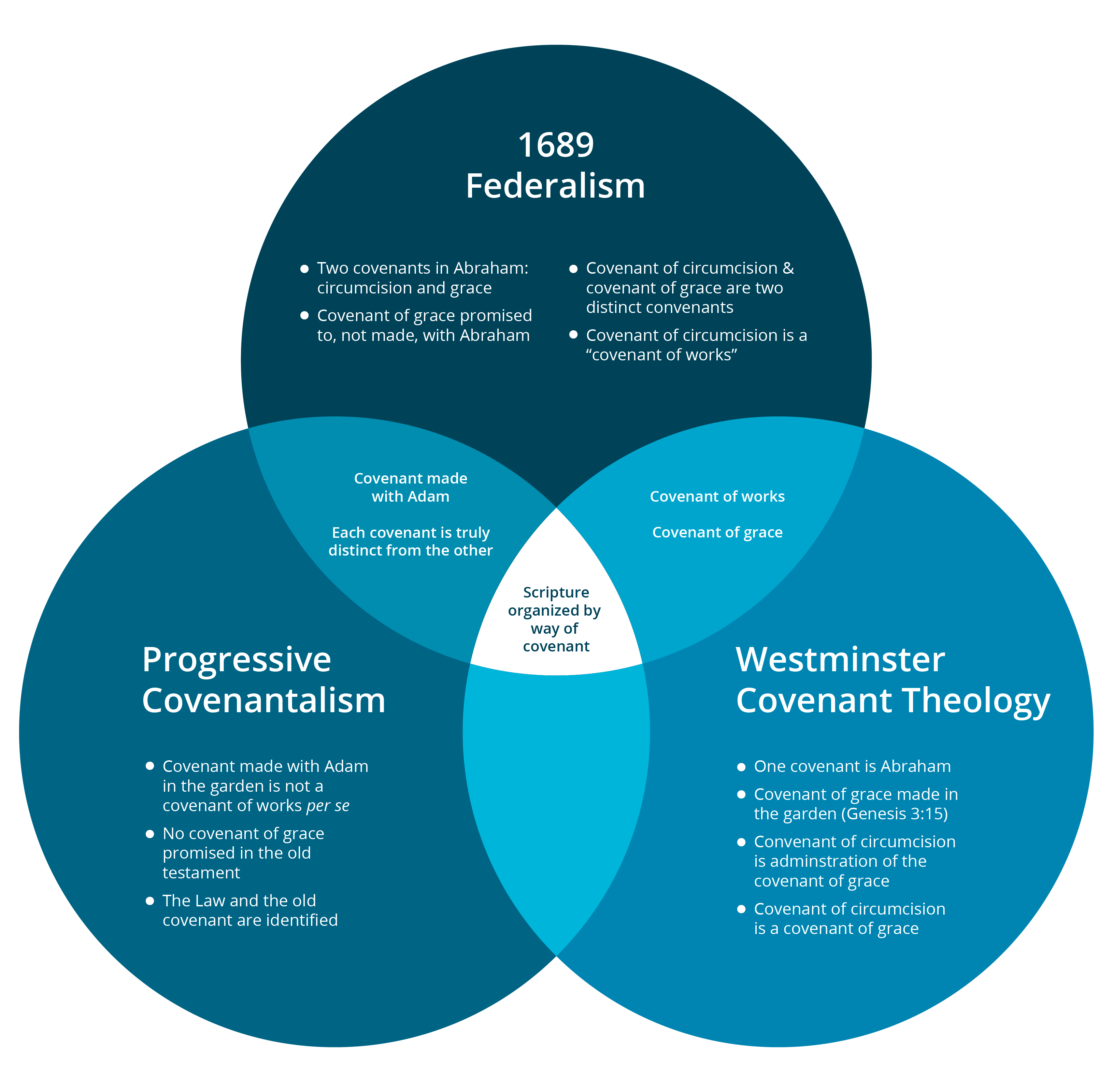
Chart Credit: Paola Ely (Twitter: @paola_palooza)
Chart Source: http://keepingthemainthing.blogspot.com/2018/11/a-chart-on-covenant-theology.html
Progressive covenantalism teaches that the covenant with Adam was not a covenant of works and that no Old Testament covenant could truly be considered a covenant of grace. As you can see from the chart above, the two more traditional views separate from each other on how to handle the covenant with Abraham. Again, the differences between various covenantal approaches are small compared to the differences between the various branches of dispensationalism. One further thing to note is that covenantalists tend to be Reformed (Calvinist). However, John Wesley produced an Arminian version of covenantalism where he stopped the covenant of works at the sin of Adam and began the covenant of grace simultaneously.[5]
The middle of the continuum
In the middle of the continuum, there are three views: progressive dispensationalism, progressive covenantalism, and new covenant theology. Since we have already spent a great deal of time discussing progressive dispensationalism above, I will begin discussing new covenant theology.
New covenant theology (NCT as it is commonly abbreviated) views the Bible centered on the new covenant, as the name implies. Proponents of NCT view their theology as being entirely Christ-centered. The whole plan of God is for Christ to come and redeem mankind. After the redemption, in essence, the rules change forever. Practically speaking, someone who believes in NCT teaches that the Old Testament laws have been completely done away with in Christ. Those laws have been replaced entirely by the law of Christ found in the new covenant. The New Testament should interpret the Old Testament, not vice versa. Proponents of NCT believe that the Old Testament (or Old Covenant) was temporary for a reason, and that the New Covenant has completed replaced it. One of the more radical pieces of NCT according to critics is the rejection of the “tripartite nature” of the Mosaic Law. Most covenantalists believe that the Law should be divided into three sections: moral, civil, and ceremonial. For a covenantalist, the moral law remains in effect outside of any covenant, and thus, apply to all Christians today. For the NCT believer, the only Law that applies to the Christian is the Law of Christ. Finally, the NCT view of the Israel-Church distinction is interesting. For the covenantalist, the Church was the ultimate goal of God. Israel was the means of bringing Christ into the world, and then once Christ came and established the Church, the Church became the new Israel (Israel = Church). For the dispensationalist, the Church and Israel are always and forever separate plans of God (Israel ≠ Church). For the NCT proponent, Jesus is the focal point of Israel’s history. He is the consummate Israelite. And through and in Jesus, the Church has access to God and to the promises (Israel = Jesus = Church).[6]
Similar to NCT is progressive covenantalism, which was first named by Baptist scholars Peter Gentry and Stephen Wellum in their book Kingdom Through Covenant. From their book: “It is our conviction that the present ways of unpacking the biblical covenants across the Canon, especially as presented by dispensational and covenant theology (and their varieties), are not quite right. That is why we believe it is time to present an alternative reading which seeks to rethink and mediate these two theological traditions in such a way that we learn from both of them but also provide an alternative—a via media.… In identifying our proposal as ‘progressive covenantalism,’ or a species of ‘new covenant theology,’ we are stressing two points. First, it is a via media between dispensational and covenant theology. It neither completely fits nor totally disagrees with either system. Second, it stresses the unity of God’s plan which is discovered as we trace God’s redemptive work though the biblical covenants. It is not our desire to focus on the new covenant to the exclusion of the other covenants; rather we are concerned with each and every biblical covenant. Yet, given the fact that God has progressively revealed his eternal plan to us over time and through the covenants, in order to discern God’s plan correctly we must understand each biblical covenant in its own redemptive-historical context by locating the covenant in relationship to what precedes it and what comes after it.” [7] Wellum and Gentry see their contribution as a middle ground between covenantalism and dispensationalism rooted in some aspects of the NCT movement.
So, how does progressive dispensationalism differ from NCT and progressive covenantalism? There is still a nuanced difference in how Israel and the Church relate. Progressive dispensationalists are still dispensationalists, after all. While NCT would argue that the Church is identified with Israel through and in Jesus, progressive dispensationalists would say that Israel and the Church are still somewhat separate. In the future, promises received will be based on ethnicity and identification with Christ, not identification with Christ alone. Other small differences include how time is arranged (covenants versus dispensations) and how the end-times will look. From a macro level, progressive dispensationalists share much with proponents of NCT.
The spectrum
Given the discussion above, I wanted to provide a spectrum of belief in the chart below. I have placed various theologians on the spectrum where they belong.
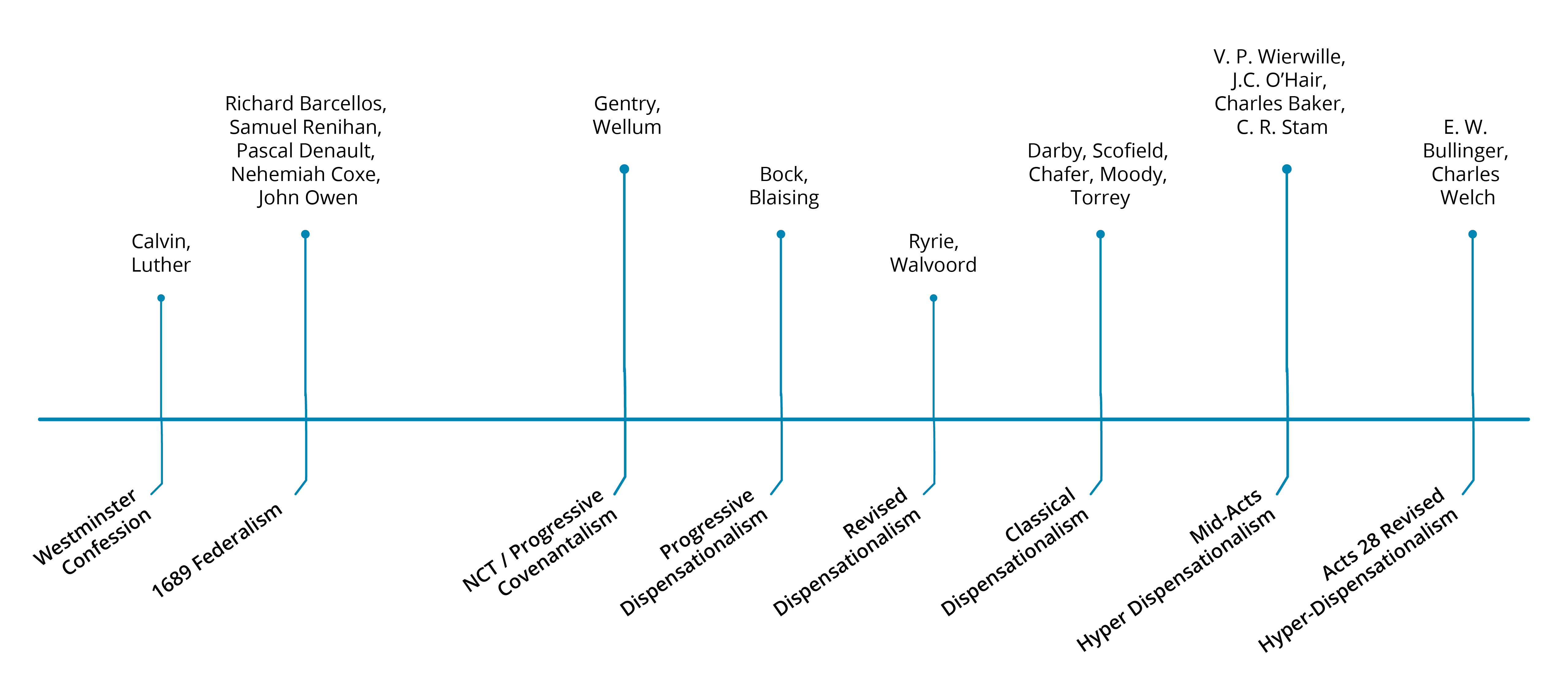
Chart Credit: Paola Ely (Twitter: @paola_palooza)
Conclusion
What we think about time periods directly informs our interpretation and application of Scripture. That is why it is of critical importance to consider and reconsider our views on these issues. Where do you currently stand on these issues? I know that I find myself somewhere in the middle of the spectrum. I think that there is value in a balanced perspective between continuity and discontinuity. Like I said in the series a few years ago, I try to avoid labels. And truth be told, I don’t neatly fit into one of these buckets. If I had to put a label on myself, I would probably say that I am a progressive covenantalist—more on why in a later article. But I am still endeavoring to search the Bible and evaluate these possibilities based on what I find in the text. In the weeks and months ahead, we will consider some of the Scriptural issues that place people on various parts of the spectrum.
For Further Study
Wellum and Gentry, Kingdom Through Covenant
Blasing and Bock, Dispensationalism, Israel, and the Church: A Search for Definition
Blasing and Bock, Progressive Dispensationalism
Wells and Zaspel, New Covenant Theology
Schreiner, New Testament Theology: Magnifying God in Christ
Reisinger, Abraham’s Four Seeds
Pink, The Divine Covenants
Renihan, The Mystery of Christ, His Covenant, and His Kingdom
Barcellos, The Covenant of Works: Its Confessional and Scriptural Basis
Calvin, Institutes of the Christian Religion, Book 2, Chapters 10-11
Coxe & Owen, Covenant Theology: From Adam to Christ
https://www.1689federalism.com
https://en.wikipedia.org/wiki/Covenant_theology
https://en.wikipedia.org/wiki/Dispensationalism
https://en.wikipedia.org/wiki/Progressive_dispensationalism
https://en.wikipedia.org/wiki/New_Covenant_theology
https://crosstocrown.org (NCT organization)
https://www.the-highway.com/dispensationalism_Duncan.html
1 Wellum and Gentry, Kingdom Through Covenant, page 42.
2 See Wellum and Gentry, Kingdom Through Covenant, pages 40-56.
3 See Wikipedia entry for “hyperdispensationalism” https://en.wikipedia.org/wiki/Hyperdispensationalism
4 See Wikipedia entry for “hyperdispensationalism” https://en.wikipedia.org/wiki/Hyperdispensationalism
5 See Wikipedia entry for “Covenant Theology” https://en.wikipedia.org/wiki/Covenant_theology. There are other Arminian ways of viewing covenant theology that date from before Wesley, but his view is popular in modern circles.
6 For more information on NCT, see https://crosstocrown.org/about/what-is-new-covenant-theology/
7 Wellum and Gentry, Kingdom Through Covenant, pages 23-24.

Pingback: Time Periods in the Bible: Questioning Classical Dispensationalism – Kingdom of God and Kingdom of Heaven – Study Driven Faith
2 Corinthians 4:6-18 CSB
6 For God who said, “Let light shine out of darkness,” has shone in our hearts to give the light of the knowledge of God’s glory in the face of Jesus Christ.
Treasure in Clay Jars
7 Now we have this treasure in clay jars, so that this extraordinary power may be from God and not from us. 8 We are afflicted in every way but not crushed; we are perplexed but not in despair;
we are persecuted but not abandoned; we are struck down but not destroyed.
10 We always carry the death of Jesus in our body, so that the life of Jesus may also be revealed in our body.
11 For we who live are always given over to death because of Jesus, so that Jesus’ life may also be revealed in our mortal flesh.
12 So death works in us, but life in you.
13 And since we have the same spirit of faith in accordance with what is written, I believed, therefore I spoke, we also believe, and therefore speak,
14 knowing that the One who raised the Lord Jesus will raise us also with Jesus, and present us with you.
15 For all this is because of you, so that grace, extended through more and more people, may cause thanksgiving to overflow to God’s glory.
16 Therefore we do not give up; even though our outer person is being destroyed, our inner person is being renewed day by day.
17 For our momentary light affliction is producing for us an absolutely incomparable eternal weight of glory.
18 So we do not focus on what is seen, but on what is unseen; for what is seen is temporary, but what is unseen is eternal.
We have this time on earth to stand against the adversary in the strength of God and throw God’s Word at the enemy to bring down the Devil’s strongholds just as David brought down the devilish giant.
God calls the time on earth a moment compared to all to all eternity.
God doesn’t want us to give up.
God didn’t want Paul to give up either so God gave Paul a glimpse of the future since at that time God’s Book of Revelation wasn’t available at that time to read.
Revelation answers many of the questions we have about the future.
Many of the details are shared in the Old Testament as well.
Most of us understand well Mathew to Jude because we have spent time studying those books.
We don’t understand Revelation because we haven’t taken the time to read it.
That 1000 year period of Jesus Christ’s reign on earth as King and High Priest in Revelation 20 fullfills much of the Old Testament.
Therefore it’s important to study Genesis to Revelation.
You will be surprised at how much of the Old Testament is quoted on Pentecost to Jude.
Yes, the Old Testament is for our learning and Acts to Jude is the now of our walk with God in this Grace Administration but God has blessed us with Genesis to Revelation.
I don’t always have time to sit down and read God’s Word but I can listen to God’s Word from Genesis to Revelation over and over again in different Bible Versions to get greater understanding.
Compared to the Bible Translators since 1995, today we have 1000s of Biblical Manuscripts in Hebrew, Aramaic and Greek available on our cellphones.
Many of us had to lug around 1000s of Biblical reference books before 1995.
With the internet, we have it all on our light weight cell phones. Thank God for that!
In 1988 I moved to Taiwan and I moved at least 200 pounds of Biblical Reference books as well.
And up until 2006, I had 1000s more and even opened a private community library to the public.
Since moving to our tiny apartment, I gave away most books to local churches and sold by the pound to used bookstores.
Revelation 1:1-3
The revelation of Jesus Christ that God gave Him to show His slaves what must quickly take place. He sent it and signified it through His angel to His slave John,
2 who testified to God’s word and to the testimony about Jesus Christ, in all he saw.
3 BLESSED IS THE ONE WHO READS
and
BLESSED ARE THOSE WHO HEAR THE WORDS OF THIS PROPHECY AND KEEP WHAT IS WRITTEN IN IT, BECAUSE THE TIME IS NEAR!